Marketing

A Beginner’s Guide to Understanding How Google Ads Work

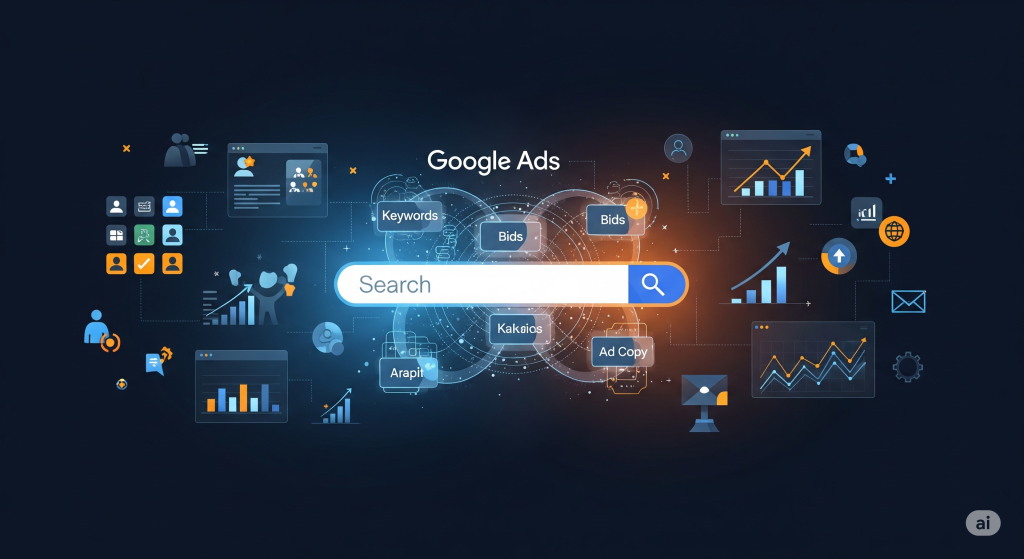
A Beginner’s Guide to Understanding How Google Ads Work Whether you’re a small business owner, a marketing manager, or just curious about digital advertising, understanding how Google Ads work is a crucial step toward increasing your online visibility and driving qualified leads. Google Ads (formerly known as Google AdWords) is one of the most powerful platforms in digital marketing, but it can feel overwhelming if you’re new to it. In this guide, we’ll break down the basics of Google Ads, how the platform works, and how you can start leveraging it to meet your marketing goals. What Is Google Ads? Google Ads is an online advertising platform developed by Google, where advertisers bid to display brief advertisements, product listings, or videos to web users. These ads can appear in Google Search results, on YouTube, in Gmail, and across millions of websites in the Google Display Network. The most common format is Search Ads—the sponsored results you see at the top of a Google search page. How Do Google Ads Work? At its core, Google Ads operates on a pay-per-click (PPC) model. That means you only pay when someone clicks on your ad. Here’s a breakdown of how it works: 1. Keywords Are the Foundation When you create a campaign, you choose keywords—terms or phrases your potential customers might type into Google when looking for products or services like yours. For example, a bakery in Austin might target “custom birthday cakes Austin.” 2. The Auction System Google runs a lightning-fast auction every time someone performs a search. Advertisers with relevant keywords can enter the auction, and Google uses a combination of factors to determine whose ad shows and in what order: Bid amount – How much you’re willing to pay per click. Quality Score – A score based on your ad’s relevance, expected click-through rate, and landing page experience. Ad Rank – This is your bid multiplied by your Quality Score. It determines your ad position. 3. Ad Formats and Placements Google Ads offers multiple ad formats: Search Ads – Appear on Google search results pages. Display Ads – Banner ads on websites in the Google Display Network. Video Ads – Primarily on YouTube. Shopping Ads – For e-commerce products with images and pricing. App Ads – Promote mobile apps across Google’s properties. As a beginner, most people start with Search Ads because of their high intent—users are actively searching for what you offer. Key Components of a Google Ads Campaign To launch an effective campaign, you’ll need to understand these core elements: Campaign – The highest-level structure. You choose your goals, budget, and settings here. Ad Groups – Each campaign contains ad groups that house related keywords and ads. Keywords – Trigger your ads based on user search queries. Ads – The text (or image/video) people actually see. A good ad is clear, relevant, and includes a strong call-to-action. Landing Page – Where users go after clicking. A relevant, fast, and optimized landing page improves Quality Score and conversions. Why Quality Score Matters Google rewards relevance. The better your ad experience—from keyword to landing page—the higher your Quality Score. A higher Quality Score can: Lower your cost-per-click (CPC) Improve your ad position Increase your return on investment (ROI) In short, you can pay less and rank higher if your ads are well-optimized. How Much Does It Cost? Google Ads offers complete control over your budget. You set: A daily budget per campaign A maximum bid per keyword Optional automated bidding strategies based on your goals (like maximizing conversions or clicks) Costs vary widely depending on industry, competition, and location. In high-competition industries (like legal or insurance), you might pay $20–$50+ per click. In less competitive niches, clicks can be under $1. Getting Started: Tips for Beginners Start with a Small, Focused CampaignChoose one product or service to advertise, and build a tight ad group around highly relevant keywords. Use Exact Match and Phrase Match KeywordsAvoid broad matches in the beginning—they can drain your budget with irrelevant clicks. Write Compelling Ad CopyHighlight benefits, include your keywords, and use strong calls-to-action. Optimize Your Landing PageMake sure it aligns with your ad and delivers a great user experience. Track EverythingUse conversion tracking and link Google Ads with Google Analytics to measure what’s working. Final Thoughts Google Ads isn’t magic, but it is a proven, data-driven way to reach customers who are actively searching for what you offer. With a clear understanding of how it works and a strategic approach, even beginners can see strong returns from their ad spend. As you grow more comfortable, you’ll discover deeper optimization tactics—like A/B testing ads, using negative keywords, and setting up remarketing campaigns—that can elevate your performance even further. At DataSciMarketing.com, we believe in using data to drive smart marketing. Google Ads provides a goldmine of that data—it’s just a matter of knowing how to use it. Ready to dive deeper into paid search or want help launching your first campaign?Stay tuned for our next guide on Google Ads keyword strategies, or contact our team to talk with a digital marketing expert.

A Beginner’s Guide to Understanding How Google Ads Work Read More »

Simple Marketing Plan for Small Businesses

Your no-nonsense guide to a small business marketing plan Your business does not need a 50-page marketing document collecting dust. It needs a lean, actionable plan that drives results. Forget the complexity. Here is how you build a marketing plan that works. Who are you actually selling to? You cannot market effectively to everyone. Pinpoint your exact target audience with precision. Who benefits most from your product or service? What are their demographics, such as age, location, income level, and occupation? More critically, delve into their psychographics: what are their interests, values, lifestyles, and attitudes? Understand their deepest pain points and most pressing aspirations.   Create detailed buyer personas – semi-fictional representations of your ideal customers. Give them names, backstories, motivations, and even challenges. This foundational step dictates every subsequent marketing effort, from the messaging you use to the channels you select. Without this deep understanding, you are wasting resources on broad, ineffective campaigns that speak to no one specifically and resonate with even fewer. Knowing your customer is the bedrock of all successful marketing. Craft your unique value proposition Why should customers choose you over competitors? Your unique value proposition (UVP) is not a slogan; it is a clear, compelling statement of the specific benefits you offer and why you are fundamentally different and superior. Do you provide a product with unparalleled quality, a service at a significantly lower price point, an exceptionally personalized customer experience, or a groundbreaking feature that solves a common problem?   Articulate your UVP concisely and prominently across all your marketing materials. It must resonate immediately with your ideal customer and address their needs or desires. Your UVP answers the critical question: “Why should I buy from you?” If you cannot articulate this succinctly, neither can your potential customers. A strong UVP provides a competitive edge and justifies your existence in the market. Set measurable marketing goals Vague goals yield vague results. Your marketing objectives must be SMART: Specific, Measurable, Achievable, Relevant, and Time-bound. Instead of saying, “I want more sales,” define it precisely. Do you want to increase website traffic by 20% in the next six months by investing in SEO? Do you aim to generate 50 new qualified leads per quarter through content marketing? Perhaps you intend to boost sales of a specific product by 15% by year-end via social media campaigns.   Establish clear key performance indicators (KPIs) and metrics for success from the outset. This allows you to track progress, evaluate the effectiveness of your strategies, and make data-driven decisions. Without measurable goals, you are navigating blind; you will never know if your efforts are truly paying off or if you are merely spinning your wheels. Choose your marketing channels Do not try to be everywhere at once. Focus your resources on the channels where your ideal customer spends their time and is most receptive to your message. If your audience is primarily Gen Z and consumes video content, investing heavily in platforms like TikTok or YouTube makes sense. If your target is B2B professionals, LinkedIn and industry-specific newsletters might be more effective. Common channels include: Content marketing: Create valuable blogs, articles, videos, podcasts, and guides that address your audience’s questions and problems, establishing your authority and trust. Social media marketing: Engage organically and through paid advertisements on platforms like Instagram, Facebook, LinkedIn, X (formerly Twitter), or Pinterest, depending on where your audience congregates. Search engine optimization (SEO): Optimise your website content and technical aspects to rank higher in Google and other search engine results, driving organic traffic. Email marketing: Build an email list and send targeted newsletters, promotions, and updates to nurture leads and retain customers. Paid advertising: Utilise platforms like Google Ads for search and display campaigns, or social media ads on Facebook/Instagram to reach specific demographics with precision. Local marketing: Optimise your Google My Business profile, engage in local community sponsorships, and ensure your business is listed in local directories if you serve a geographic area.   Prioritise two to three channels initially. Master them, understand their nuances, and track their performance rigorously before considering expansion into new areas. Spreading yourself too thin across too many channels leads to diluted effort and minimal impact. Allocate your budget Marketing requires investment, and you must treat it as such, not an optional expense. Determine how much you can realistically spend on marketing and allocate those funds strategically across your chosen channels based on their potential ROI. Consider both the cost of advertising placements and the resources required for content creation, tools, and potentially staffing.   Track your return on investment (ROI) meticulously for each marketing activity. Use analytics to see which campaigns are generating leads, driving sales, or achieving your specific goals. If a channel is not delivering the expected results, be prepared to reallocate funds to more effective strategies. Your budget is a dynamic tool; adjust it based on performance data, not on guesswork or habit. Create your content plan Once your channels are chosen, develop a detailed content calendar. What specific content will you create for each channel? When will it be published? How does it align with your overall marketing goals and your customer’s journey? This goes beyond just writing; it involves planning visuals, video scripts, ad copy, and email sequences.   Consistency is paramount. Regular, high-quality content keeps your audience engaged, improves your SEO, and reinforces your brand message. Your content must align directly with your unique value proposition and consistently address your target audience’s needs, questions, and interests. A well-structured content plan ensures you always have a pipeline of valuable material ready for deployment, avoiding last-minute scrambling and maintaining brand presence. Implement and iterate Execute your plan, but do not stop there. Marketing is an ongoing, iterative process of testing, measuring, and refining. Launch your campaigns, then monitor your analytics constantly. Which headlines generate the most clicks? Which calls to action convert best? Which content formats resonate most with your audience? Be agile. Adjust your strategies based on concrete data, not assumptions or

Simple Marketing Plan for Small Businesses Read More »

How to Make Your Content Readable and Friendly for Search Engines

How to Make Your Content Readable and Friendly for Search Engines Search engines process information like humans: they value clarity, relevance, and a positive user experience. Crafting content that satisfies both readers and algorithms is not a balancing act; it’s a synergistic approach. Prioritise readability and search engine friendliness from the outset. Structure your content for clarity Organised content is easily digestible for readers and efficiently parsed by search engine crawlers. Implement a logical hierarchy using headings and subheadings. Each section should flow naturally into the next, guiding the reader through your narrative.   Use <h1> for your main title, then <h2> for major sections, and <h3> or <h4> for subsections. This not only improves scannability for users but also signals to search engines the relative importance of different content blocks. Breaking up large blocks of text with shorter paragraphs and bullet points enhances readability, preventing reader fatigue and making your content more inviting. Write in plain language Avoid jargon and overly complex sentence structures. Your goal is to communicate effectively, not to impress with an extensive vocabulary. Write as if you are explaining a concept to a knowledgeable but non-expert audience. Simple, direct language resonates with a broader readership and is more readily understood by search engine algorithms.   Focus on conciseness. Eliminate unnecessary words and phrases. Active voice generally leads to more direct and impactful sentences than passive voice. For example, instead of “The report was written by the team,” write “The team wrote the report.” This makes your writing more dynamic and easier to follow. Optimise for relevant keywords Keyword research is fundamental to search engine optimisation (SEO). Identify the terms and phrases your target audience uses when searching for information related to your content. Integrate these keywords naturally throughout your text, including in headings and the first paragraph. Do not stuff keywords, as this degrades readability and can incur search engine penalties. LSI (latent semantic indexing) keywords, which are semantically related to your main keywords, further enhance your content’s relevance. For instance, if your primary keyword is “data science,” LSI keywords might include “machine learning,” “artificial intelligence,” or “statistical analysis.” Use tools to identify these related terms and weave them into your content to provide greater context and depth. Enhance with multimedia Visual elements like images, infographics, and videos break up text and make content more engaging. They can explain complex concepts more effectively than text alone and cater to different learning styles. For search engines, descriptive alt text for images is crucial. Alt text helps search engines understand the content of your images, contributing to better image search rankings.   Ensure all multimedia is optimised for web performance. Large file sizes can slow down your page loading speed, a critical factor for both user experience and SEO. Compress images without sacrificing quality and consider using responsive design principles so your multimedia displays correctly across all devices. Prioritise mobile responsiveness A significant portion of web traffic originates from mobile devices. Your content must be accessible and readable on smartphones and tablets. Responsive design ensures your website adapts seamlessly to different screen sizes, providing an optimal viewing experience for all users. Search engines favour mobile-friendly websites, often penalising those that are not. Regular testing across various devices confirms your content remains visually appealing and functional, no matter the screen. Implement internal and external links Strategic linking improves both user experience and SEO. Internal links connect related content within your own website, guiding users to more information and distributing link equity. External links, when directed to reputable, authoritative sources, add credibility to your content and provide further value to your readers. Ensure all links are relevant and functional, avoiding broken links that detract from the user experience.   By focusing on clear structure, plain language, strategic keyword use, multimedia integration, mobile responsiveness, and effective linking, you create content that is both readable for your audience and highly visible to search engines.

How to Make Your Content Readable and Friendly for Search Engines Read More »

Stop Guessing: Simple Keyword Research Strategies for Small Businesses

Stop guessing: simple keyword research strategies for small businesses </h1 > In the vast digital ocean, getting your small business noticed can feel like finding a needle in a haystack. You’ve got a fantastic product or service, but how do potential customers find you amidst all the noise? The answer often lies in understanding what they’re searching for – and that’s where simple keyword research comes in. You know your business inside and out. You know what you sell and who you sell it to. But do you know the exact words they type into a search engine to find you? If not, you’re flying blind. Keyword research isn’t just for big companies with dedicated marketing departments. It’s a fundamental practice for any small business that wants to be found online. Start with what you know Before you touch any tool, start with your own expertise. You understand your customers’ problems and the language they use to describe them. Brainstorm your services and products. List everything you offer. Be specific. Instead of “plumbing services,” write down “emergency leak repair,” “drain unblocking,” and “geyser installation.” Think like your customer. What would you search for if you needed your own services? Ask your current customers what they typed into Google to find you. You might be surprised. Create ‘keyword buckets’. Group your brainstormed terms into logical categories. For instance, a local bakery’s buckets might be “birthday cakes,” “sourdough bread,” “vegan pastries,” and “coffee shop.” Use free tools to uncover hidden gems You don’t need an expensive subscription to find valuable keywords. Free tools offer powerful insights if you know how to use them. Google is your best friend. Start typing your brainstormed terms into the Google search bar and see what autocompletes. These are real searches from real people. Also, pay close attention to the “People also ask” and “Related searches” sections on the results page. They are a goldmine of keyword ideas. Leverage Google Keyword Planner. While designed for advertisers, Google Keyword Planner is an invaluable free tool for discovering new keywords and their search volumes. You will need a Google account to access it, but you don’t have to run an ad campaign. Explore other free options. Tools like Ubersuggest and AnswerThePublic can provide you with a host of keyword suggestions, questions people are asking, and comparisons. Understand the power of long-tail and local keywords Broad, one-word keywords are often highly competitive and may not attract the right audience. The real value for small businesses lies in more specific phrases. Embrace the long-tail. Long-tail keywords are longer, more specific phrases that users type when they’re closer to making a purchase. For example, instead of targeting “shoes,” a small boutique would have more success with “handmade leather boots for women in Johannesburg.” The search volume is lower, but the intent to buy is much higher. Dominate your local market. If you’re a brick-and-mortar business or serve a specific geographic area, local keywords are non-negotiable. This is as simple as adding your city, suburb, or “near me” to your keywords. Think “best pizza in Cape Town” or “emergency plumber Pretoria East.“ Size up your competition without the complexity Analyzing your competitors’ keywords tells you what’s already working in your market. You don’t need to be an SEO expert to do a basic analysis. Identify your true online competitors. Your competitors aren’t just the businesses down the street. They are the websites that show up in Google for your target keywords. Search for your most important phrases and see who consistently ranks on the first page. See what they’re ranking for. Free versions of SEO tools often allow you to enter a competitor’s domain and get a glimpse of the keywords they rank for. Look for keywords relevant to your business that you haven’t considered. Look for ‘keyword gaps’. These are keywords your competitors are ranking for, but you aren’t. This is your opportunity to create content that fills that gap and attracts their customers. Put your keywords to work Finding the right keywords is only half the battle. You need to use them effectively on your website. Assign one primary keyword to each important page. Your homepage, service pages, and product pages should each target a specific primary keyword. Weave keywords naturally into your content. Include your primary keyword in the page title, headings, and the body of the text. Also, sprinkle in relevant long-tail and related keywords. Do not “keyword stuff” – write for humans first, search engines second. Create blog content around question-based keywords. The “People also ask” section on Google is a direct line to your customers’ questions. Answer these questions in detailed blog posts to establish your authority and attract relevant traffic.

Stop Guessing: Simple Keyword Research Strategies for Small Businesses Read More »

How to Find Your Best Marketing Audience

How to Find Your Best Marketing Audience In today’s crowded digital landscape, shouting your marketing message to everyone is like whispering in a hurricane. It’s inefficient, expensive, and ultimately ineffective. The key to successful marketing lies in identifying and connecting with the right audience – the people who are most likely to be interested in your products or services and become loyal customers.   This comprehensive guide will walk you through the essential steps of finding your best marketing audience, providing actionable strategies and real-world examples to illuminate the process. Why Defining Your Target Audience Matters Before diving into the “how,” let’s understand the “why.” Clearly defining your target audience offers numerous benefits: Increased Marketing ROI: By focusing your efforts on those most likely to convert, you’ll see a better return on your marketing investment. No more wasted ad spend on uninterested individuals. More Effective Messaging: When you understand your audience’s needs, pain points, and aspirations, you can craft compelling and relevant marketing messages that resonate deeply. Improved Product Development: Understanding your ideal customer can inform your product development roadmap, ensuring you’re creating solutions that truly meet their needs. Stronger Brand Loyalty: When customers feel understood and catered to, they are more likely to become loyal advocates for your brand. Competitive Advantage: By nicheing down and focusing on a specific audience, you can become a go-to expert in that area, giving you a significant competitive edge. Step 1: Deep Dive into Your Existing Customers Your current customer base is a goldmine of information. Analyzing their characteristics and behaviors can provide valuable insights into who is already finding value in your offerings. Demographics: Gather data on age, gender, location, income, education, and occupation. Example: A small online retailer selling sustainable baby clothes analyzes their customer data and finds that 75% of their customers are women aged 25-40, residing in urban areas, with a household income of $70,000+, and a strong interest in eco-conscious living. Psychographics: Understand their values, interests, attitudes, and lifestyle. Example: The same baby clothes retailer might find through surveys and social media analysis that their customers value natural materials, ethical sourcing, and minimalist aesthetics. They are likely interested in parenting blogs, sustainable living communities, and brands with a strong social mission. Behavioral Data: Analyze how they interact with your brand – what products they buy, how often they purchase, what channels they use, and how they engage with your content. Example: The retailer discovers that their average customer makes 3 purchases per year, primarily through their website, and frequently engages with their Instagram posts about the benefits of organic cotton. Conduct Customer Surveys and Interviews: Directly ask your customers about their needs, motivations, and experiences. Example: The retailer sends out a post-purchase survey asking about what factors influenced their decision to buy and what other baby-related products they are interested in. They also conduct a few in-depth interviews with loyal customers to gain deeper qualitative insights. Step 2: Conduct Market Research Go beyond your existing customers and explore the broader market to identify potential new audience segments. Competitor Analysis: Analyze your competitors’ target audiences. Who are they trying to reach? What marketing strategies are they using? This can reveal underserved niches or potential overlaps. Example: The baby clothes retailer observes that some competitors focus heavily on budget-friendly options, while others target luxury consumers. This identifies a potential opportunity to further emphasize the value proposition of their sustainable and ethically produced clothing at a mid-range price point. Industry Trends: Stay informed about emerging trends and shifts in consumer behavior within your industry. Example: The retailer notes the growing trend of parents seeking organic and natural products for their children, reinforcing their focus on sustainable materials. Social Listening: Monitor social media conversations, online forums, and review sites to understand what people are saying about your industry, your competitors, and their own needs and pain points. Example: By monitoring relevant hashtags and online communities, the retailer identifies conversations about skin sensitivities in babies and the desire for clothing made without harsh chemicals, further validating their product focus. Utilize Market Research Tools: Explore tools like Google Trends, industry reports, and audience analysis platforms to gather data on demographics, interests, and online behavior. Example: Using Google Trends, the retailer sees a consistent increase in search interest for terms like “organic baby clothes” and “sustainable baby brands” over the past few years. Step 3: Create Buyer Personas Based on your research, create detailed fictional representations of your ideal customers. These “buyer personas” humanize your target audience and make it easier to understand their motivations and needs. Give them a name: (e.g., “Sarah the Sustainable Mom”) Include demographic details: (Age: 32, Location: Suburban, Income: $85,000, Occupation: Marketing Manager) Describe their psychographics: (Values: Sustainability, health, family. Interests: Yoga, farmers markets, conscious parenting blogs. Challenges: Finding safe and eco-friendly products within her budget.) Outline their goals and motivations: (Wants the best for her baby’s health and the planet. Seeks high-quality, durable clothing that aligns with her values.) Detail their buying behavior: (Researches products online, reads reviews, prefers brands with transparent sourcing, shops online monthly.) Identify their pain points: (Concerned about harmful chemicals in conventional clothing, frustrated by fast fashion waste, sometimes struggles to find affordable and sustainable options.) Step 4: Segment Your Audience (If Necessary) Depending on the diversity of your ideal customers, you might need to segment your audience into smaller, more specific groups based on shared characteristics. This allows for more targeted messaging and tailored marketing campaigns. Example: The baby clothes retailer might identify two key segments: “Eco-Conscious New Parents” (like Sarah) and “Practical Value Seekers” (who prioritize durability and affordability but are still open to sustainable options if the value proposition is clear). They can then create slightly different marketing messages and promotions for each segment. Step 5: Choose the Right Marketing Channels Once you have a clear understanding of your target audience, you can strategically select the marketing channels where they spend their time and are most likely to engage with your

How to Find Your Best Marketing Audience Read More »

Uncovering Hidden Opportunities for Organic Growth

Uncovering Hidden Opportunities for Organic Growth Hey everyone! So, I’ve been diving headfirst into the world of data science, and let me tell you, it’s been a wild ride. As a marketer, I’ve always known SEO was important, but now I’m seeing it through a whole new lens. Are you still relying solely on keyword volume to drive your SEO strategy? Because, trust me, you’re missing out on a ton of insights hidden in your data. Let’s talk about how data science is totally changing the SEO game!   Traditional SEO vs. Data Science: A Lightbulb Moment   For years, SEO felt like a guessing game. You’d pick keywords based on volume, check out your competitors, and hope for the best. But data science? It’s like putting on night-vision goggles in a dark room. Suddenly, you can see everything.   One of the coolest things I’ve been playing with is Natural Language Processing (NLP). Forget just looking at keyword volume. NLP lets you understand what people actually mean when they search. For instance, instead of just targeting “best running shoes,” I can see that people are also searching for “running shoes for flat feet” and “running shoes for pronation.” This means I can create super-specific content that nails what people are looking for.   Alright, let’s get a bit technical. I’ve been experimenting with Python to automate some of the tedious parts of SEO, like checking for broken links. Here’s a simple script that shows you how to do it. Keep in mind, this is a basic example, but it’s a great starting point.” Python   import requests from bs4 import BeautifulSoup import urllib.parse def check_broken_links(url): “””Checks for broken links on a given URL.””” try: response = requests.get(url) response.raise_for_status() # Raise HTTPError for bad responses (4xx or 5xx) soup = BeautifulSoup(response.content, ‘html.parser’) links = [a.get(‘href’) for a in soup.find_all(‘a’, href=True)] broken_links = [] for link in links: absolute_link = urllib.parse.urljoin(url, link) #Makes relative links absolute try: link_response = requests.head(absolute_link, allow_redirects=True) if link_response.status_code >= 400: broken_links.append(absolute_link) except requests.exceptions.RequestException as e: broken_links.append(f”{absolute_link} – {e}”) #if there is an error, append that to the list. if broken_links: print(f”Broken links found on {url}:”) for broken_link in broken_links: print(f”- {broken_link}”) else: print(f”No broken links found on {url}.”) except requests.exceptions.RequestException as e: print(f”Error checking {url}: {e}”) # Example usage: check_broken_links(“https://yourwebsite.com”) # Replace with your website URL. Let’s break down what this code does: Imports: We import the requests library to fetch web pages, BeautifulSoup to parse HTML, and urllib.parse to handle URL manipulation. check_broken_links(url) function: It takes a URL as input. It uses requests.get() to fetch the page content. response.raise_for_status() will stop the code if there is an error. BeautifulSoup parses the HTML, and we find all the <a> tags (links). We then use a loop to check each link. urllib.parse.urljoin() is used to make all relative links absolute. requests.head() is used to get the header of the link and check the status code. If the status code is 400 or higher, we add it to the broken_links list. We print the broken links (if any). Example Usage: We call the function with your website’s URL. This is a simple example, but it shows how Python can automate tasks that would take hours to do manually. You can build on this by adding features like recursive crawling (checking links on linked pages) or exporting the results to a CSV file.   Peeking at the Competition (But, Like, With Data) We all check out our competitors, right? But data science takes it to a whole new level. Instead of just looking at their keywords, I’m digging into their backlink profiles. I’m using tools to see which links are good and which are kinda…spammy. With Python and some web scraping, I’ve been able to automate the process of finding content gaps. I compare my content to my competitors and see where I’m missing out.   I also set up some dashboards to track how my competitors’ rankings and traffic change over time. It’s like having a real-time report on what they’re doing and how it’s working.   User Behavior: Getting Inside Their Heads (With Data)   Forget about just looking at page views. I’m diving deep into user behavior. I’m using Google Analytics to see how people interact with my site – where they click, how long they stay, and where they leave. I’ve even started setting up funnel visualizations to see the exact path users take to conversion.   And you know those weird spikes in traffic? Data science can help you spot those anomalies. I’m using statistical methods to see if those spikes are good (like a viral post) or bad (like a bot attack).   Making My Site Rank Better (The Data-Driven Way)   I’ve been using Python to automate technical SEO audits. It’s way faster than manually checking for broken links or slow loading speeds. I’ve also been using NLP to analyze my content and see how well it matches what people are searching for.   And here’s a fun one: personalization. I’m starting to use user data to show different content to different people. It’s like tailoring my site to each visitor, which is pretty cool.   Tools and Tech (My New Best Friends)   Here are some of the tools I’ve been using: Python: For data analysis, NLP, and automating tasks. Google Analytics & Google Search Console: For all the website data. SEMrush & Ahrefs: For competitor analysis and keyword research. Tableau & Power BI: This is for making pretty charts and dashboards.   Wrapping It Up (And What’s Next)   So, yeah, that’s my journey into data-driven SEO. It’s been a learning curve, but it’s worth it. Data science isn’t just a buzzword – it’s a game-changer. If you’re serious about SEO, you need to get on board. I’m still learning, so if you have any tips or tricks, drop them in the comments! Let’s chat if you want to see how data science can boost your SEO!

Uncovering Hidden Opportunities for Organic Growth Read More »

How to Measure Your Marketing ROI? Data Science Can Help.

How to Measure Your Marketing ROI? Data Science Can Help! In today’s data-driven world, marketing success hinges on understanding the return on investment (ROI) of your campaigns. Are your marketing efforts truly driving revenue, or are you throwing money into a black hole? Many marketers struggle to accurately measure ROI, leaving them unsure of what’s working and what’s not. This is where the power of data science comes in. By leveraging data science techniques, you can gain a deeper understanding of your marketing performance and make informed decisions that maximize your ROI. The Challenge of Traditional ROI Measurement Traditional marketing ROI calculations often rely on simplified formulas, like dividing marketing spend by revenue generated. While this provides a basic overview, it often fails to capture the complexity of the customer journey and the influence of various touchpoints. For example, how do you attribute revenue generated by a customer who first saw your ad on social media, then clicked on a search engine result, and finally purchased after receiving an email newsletter? Traditional methods often fall short in accurately assigning credit across these different channels How Data Science Can Help Data science offers a more sophisticated approach to measuring marketing ROI by leveraging advanced statistical techniques and machine learning algorithms. Here are some key ways data science can help: Attribution Modeling: Instead of relying on simplistic last-click or first-click attribution, data science enables you to build more accurate attribution models. These models, like Markov chains or Shapley values, consider the sequence of touchpoints in the customer journey and assign credit proportionally to each channel’s contribution. For example, a Markov chain model can analyze the transition probabilities between different marketing channels and determine the influence of each channel on conversions. Customer Segmentation: Data science allows you to segment your audience based on demographics, behavior, and preferences. This allows you to tailor your marketing campaigns to specific segments, increasing their effectiveness and improving ROI. For instance, you might identify a high-value customer segment that responds well to email marketing and focus your efforts on that channel for this group. Predictive Analytics: By analyzing historical data, data science can predict future customer behavior and identify potential leads. This allows you to proactively target customers with personalized offers and improve conversion rates. Imagine being able to predict which leads are most likely to convert and focusing your sales efforts on those individuals. Campaign Optimization: Data science can be used to optimize marketing campaigns in real-time. For example, A/B testing can be used to compare different versions of an ad and identify which performs best. Machine learning algorithms can then automatically adjust ad spend and targeting to maximize conversions. Case Study: E-commerce Company An e-commerce company was struggling to understand the ROI of their various marketing channels. By implementing a data-driven attribution model, they discovered that their social media campaigns, while generating a lot of traffic, were not directly leading to conversions. Instead, they found that social media played a significant role in brand awareness and initial customer engagement, ultimately leading to conversions through search engine marketing. This insight allowed them to reallocate their marketing budget, investing more in search engine optimization and refining their social media strategy to focus on engagement rather than direct sales. As a result, they saw a significant increase in their overall marketing ROI. Techniques and Tools Several techniques and tools are used in data-driven marketing ROI measurement: Statistical Modeling: Regression analysis, time series analysis, and clustering are used to analyze marketing data and identify patterns. Machine Learning: Algorithms like random forests, neural networks, and support vector machines are used for predictive modeling and customer segmentation. Data Visualization: Tools like Tableau and Power BI are used to create dashboards and reports that visualize marketing performance and ROI. Marketing Analytics Platforms: Platforms like Google Analytics and Adobe Analytics provide data and tools for tracking and analyzing marketing campaigns. Measuring marketing ROI is crucial for making informed decisions and maximizing the impact of your marketing efforts. Data science provides the tools and techniques to move beyond simplistic calculations and gain a deeper understanding of your marketing performance. By embracing data-driven approaches, you can optimize your campaigns, target the right audience, and demonstrate the true value of your marketing investments. If you’re struggling to measure your marketing ROI, exploring the potential of data science is a worthwhile investment that can significantly improve your bottom line.

How to Measure Your Marketing ROI? Data Science Can Help. Read More »